




Companies operating charging infrastructure at their sites or in public spaces now need to manage more than just charge points. Energy flows, user groups, tariffs and billing all need to work together. To achieve this, 1KOMMA5° and vaylens are bringing together the Heartbeat AI Enterprise energy management system and modern charging management within a single shared setup.
As electrification increases, so does the need to treat charging infrastructure as more than a standalone function. Companies want to integrate charge points into existing energy and operational processes while accommodating different user groups and billing models; this is where the collaboration between 1KOMMA5° and vaylens comes in. Since 2025, the two companies have been working on a technical foundation for corporate sites and publicly accessible charge points.
“For us, charging infrastructure is part of a larger energy system. That makes it essential for charging processes to integrate seamlessly into our platform and for us to support different use cases and business models flexibly,” explains Marvin Endres, Managing Director B2B & B2G Solutions at 1KOMMA5°.
Division of responsibilities between energy and charging management
The two platforms perform different roles: 1KOMMA5° controls energy management and integrates charging services into its own platform. vaylens provides the Charge Point Management System (CPMS), along with functionality for processing and billing charging sessions. The two systems exchange relevant information via APIs. 1KOMMA5° defines products, tariffs and commercial terms, while vaylens handles the corresponding charging and billing processes in the backend.
This division of responsibilities allows both companies to build on their respective core strengths: 1KOMMA5° does not need to develop its own CPMS, while vaylens can integrate its charging management functionality into a broader energy platform.
Different charging scenarios on one platform
The importance of this flexibility is particularly evident at corporate sites, where several user groups may share the same charging infrastructure. Employees charge their private vehicles, company cars are charged on-site and guests can also use the available charge points.
Different access rules and tariffs often apply to these groups. Employees with company cars, for example, may charge under different terms than those with private vehicles. The relevant pricing rules can be configured for each project. Other models can also be incorporated into the shared architecture. These include community charging, public charging, and additional payment and billing options such as roaming or direct payment.
“What matters to us is that the integration does not have to be redesigned for every additional project. Standardised interfaces allow us to harmonise recurring processes and implement new charging services on an existing technical foundation,” explains Endres.
The collaboration extends beyond the technical interface. Both companies are also refining the processes that connect their systems. One example is new customer onboarding, which has been automated as part of the collaboration. Information can be exchanged between the 1KOMMA5° platform and the vaylens Portal, so there is no need to enter all the data manually into multiple systems. This makes the integration relevant at an operational level as well. As more customers, sites and charge points are added, standardised processes between the systems involved become increasingly important. Automated onboarding is therefore a key building block for scaling the joint solution and a foundation for handling recurring processes in a standardised way.
Designed for growth
The joint solution is initially intended for corporate charging infrastructure and publicly accessible charge points in Germany. These include corporate and retail sites, among others. The focus is particularly on projects with multiple charge points, where standardised interfaces and automated processes can simplify management. 1KOMMA5° and vaylens plan to integrate more than 500 additional charge points into the shared system architecture by 2027.
Energy management, charge point operation and billing remain distinct functions but work together through the shared system architecture. With this new process, 1KOMMA5° and vaylens are laying the foundation for making charging infrastructure an integral part of a broader energy solution.
About 1KOMMA5°
1KOMMA5° offers comprehensive, carbon-neutral energy solutions for residential and commercial customers, including photovoltaic systems, battery storage systems, heat pumps, air conditioning systems and EV wall chargers. The company also develops Heartbeat AI, an artificial intelligence platform that connects energy systems, optimises their operation and, in doing so, creates Europe’s largest virtual power plant.
Further information: 1komma5.com
About vaylens
Part of KOSTAL, an independent, family-owned technology group founded in 1912, vaylens develops software for organisations operating EV charging networks or managing workplace and fleet charging. The hardware-agnostic vaylens Portal brings charge point management, access and monetisation together in one system, and connects more than 60,000 charge points across Europe. Headquartered in Dortmund, Germany, vaylens has entities across Europe, including France and the UK.
Further information: vaylens.com

FAQs
You manage EV charging stations through an EV charging management software. Once your stations are connected you control everything from this platform — no need to visit each charging station in person. The main things you'll manage are:
- Who can charge — enable access by RFID card, app, or payment terminal, like vaylens' payment integrations
- What they pay — set different tariffs for different user groups (e.g. staff vs. visitors), like vaylens' Community Charging
- How power is distributed — cloud-based load management helps you maximise your charging station's performance without needing to upgrade your grid connection
- How you get paid — set your tariffs and receive earnings directly into your bank account, automatically
- Keeping everything up to date — most platforms like vaylens let you push firmware updates to your charging stations remotely, in bulk
Think of en EV charging management software as the brain behind your EV charging stations. The physical station itself can deliver electricity, but on its own it can't take payments, control who plugs in, or tell you when something's gone wrong. An EV charging station without software is just a power outlet. EV charging management software connects to your charging stations via the internet and gives you a central dashboard to run everything: setting tariffs, managing access, monitoring performance, and getting paid. Platforms like vaylens automate the day-to-day management of your EV charging stations, so you can set up, configure, and monitor your chargers individually or in bulk — and collect earnings directly into your bank account.
EV charging stations require software, because without it, they can only do one thing: push electricity. It can't take payment, manage access, balance your energy load, or tell you when it's broken. Without EV charging management software, an EV charging station simply won't work as it should. The practical upside of smart software is significant. With EV charging management software that can help you with automated billing, remote diagnostics, and usage reporting, your EV charging network can effectively run itself.
Related case studies
From customer parking to company fleets: how Sparkassen-Einkaufsgesellschaft relies on vaylens
From customer parking to company fleets: how Sparkassen-Einkaufsgesellschaft relies on vaylens
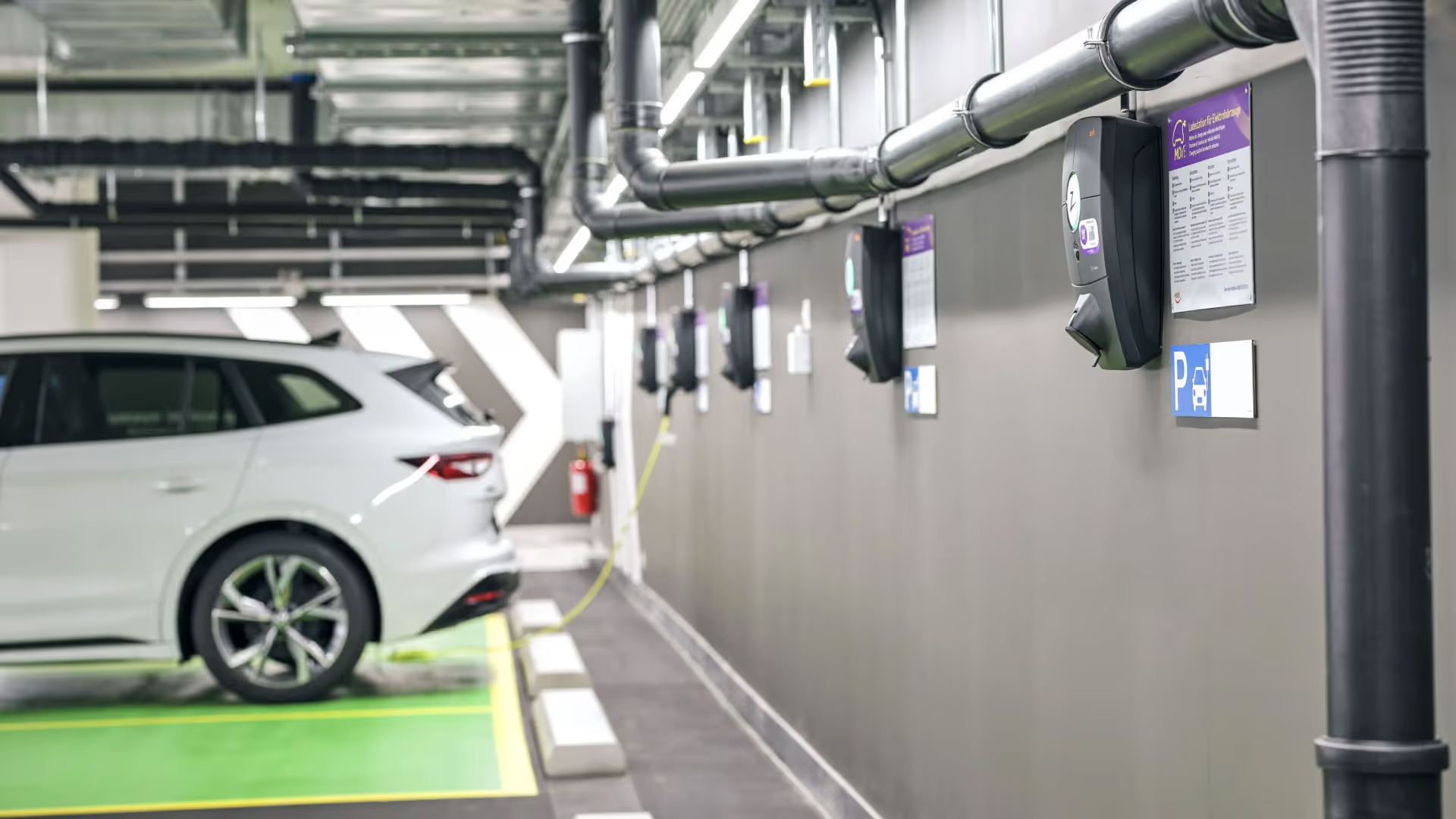
How MOVE Mobility strengthened its charging network with vaylens’ EV charging management software
How MOVE Mobility strengthened its charging network with vaylens’ EV charging management software
How BEW manages its local charging infrastructure with vaylens EV charging management software