




Unlocking the full potential of EV charging management software with APIs

EV charging management software (i.e., a Charge Point Management System, CPMS) is powerful, but many charge point operators (CPOs) and fleet operators only scratch the surface of what's possible. The reason is simple: they haven't yet discovered the full potential of using APIs in EV charging management. When used correctly, APIs can expand EV charging infrastructure management capabilities and unlock new use cases for mountains of charging data.
APIs allow different systems to communicate with each other, exchange data and automate workflows. As your EV charging infrastructure grows, requirements become more diverse, and more use cases need to be integrated with your business; API integrations for EV charging become increasingly important for sustainably supporting modern operations while adding value for different stakeholders.
In this article, you'll learn what APIs are, why they're becoming increasingly important for EV charging management software and how you can use them practically to make your processes more flexible, efficient and scalable.
What are APIs, and why are they useful for EV charging?
An API (Application Programming Interface) is a set of rules and protocols that allow different systems, like pieces of software, to communicate and exchange data with each other. Think of it as a translator between programs. Instead of manually exporting data or keeping information in various places, data flows automatically to the systems that need it.
This simple, yet common example shows how naturally APIs work: when you track a package, the customer-facing commerce app retrieves shipping updates from the logistics system automatically and displays the results (e.g., an estimated time of arrival) natively in the same app. APIs in EV charging work the same way. They transfer data about charging sessions, tariffs, access permissions or charge points directly to navigation systems, fleet platforms, billing systems or energy management tools.
vaylens offers many API integration opportunities, and the eConnect portal provides documentation of all externally available standard APIs. While many operators use vaylens' standard user interfaces, like the vaylens Portal and connectivity tester, the eConnect portal offers additional flexibility. They allow you to build custom use cases that create unique selling points or deeply integrate vaylens data and functions into your existing business workflows.
The core benefits of APIs in EV charging
APIs transform how CPOs and fleet operators work by enabling real-time data sharing, eliminating manual processes and creating a connected ecosystem. Here's what this means in practice:
Stay focussed on your core business: APIs let you integrate EV charging features and data into your existing products and services without building charging infrastructure management from scratch. This means you can focus on your core offering and customer experience, while your CPMS provider, like vaylens, handles the complex charging operations in the background.
Create unique value propositions: By integrating charging data and functionality via APIs, you can build distinctive services and features tailored to your customers' needs. Whether it's custom driver apps for utilities, integrated fleet management dashboards or specialised energy optimisation tools, APIs let you create added value that sets you apart in the market.
Integrate with existing tools: APIs connect EV charging directly with your existing business tools (fleet platforms, energy management systems, ERP, CRM and billing software) to reduce manual data entry and, invariably, errors.
Expand your automation flows: From generating daily billing reports to synchronising charge point availability across platforms, APIs automate extremely time-consuming processes that would otherwise be prone to human error.
Make your infrastructure go further: As your charging network grows or business needs evolve, APIs enable modular expansion, so you can add new integrations and functionalities without rebuilding your entire system.
Improve decision-making: Real-time data access means faster, more informed operational decisions and better transparency across your charging operations.
Different organisations use APIs in different ways. Fleet managers optimise vehicle scheduling and reporting. Housing providers automate tenant billing and access management. Workplaces control employee charging benefits efficiently. Utilities and CPOs seamlessly connect billing, roaming, and energy processes. All of them through strategic API integration.
Five practical ways to use APIs in EV charging management
1. Integrating with fleet management software
One of the most valuable applications of EV charging management software APIs is automatic synchronisation of charging data with fleet platforms. Energy consumption, charging times, vehicle status and location information become available in real-time, improving planning, reporting and vehicle utilisation.
A major German construction company demonstrates this in practice: they use vaylens' CDR API to retrieve charge data records and integrate them into their commercial reporting with Power BI. By automatically generating daily CDR files and incorporating them into their data landscape, they've created seamless Power BI reporting that gives fleet managers instant visibility into charging operations.
This approach is particularly valuable for fleet operators and municipal operators who need to optimise routes, manage charging schedules, and demonstrate cost efficiency to stakeholders.
2. Creating custom billing workflows
APIs in EV charging enable you to link EV charging management software APIs to third-party accounting or CRM tools, automating invoicing, payments, and reporting without manual intervention. This is especially useful for operators with complex tariff structures, sub-business partners, or multiple locations.
A large German utility provider exemplifies sophisticated billing integration. They use vaylens' CDR API to automatically retrieve detailed billing data, including energy consumption, duration, tariffs and status, feeding this directly into their internal billing system. The API provides comprehensive data fields covering everything from charging start and end times to detailed pricing breakdowns per kWh, per minute and per session, along with currency and invoice IDs.
vaylens enables fast and secure integrated payment for EV chargers, which works seamlessly with your existing financial systems, reducing administrative overhead and improving cash flow.
3. Automated EV driver access control
Manually managing driver permissions, RFID access or tenant billing becomes increasingly difficult as your network grows. APIs for EV charging solve this by letting you manage access rights, roles, user permissions and tariffs directly from your existing system.
The same German utility provider uses the Permission Management API to query authentication data like EMAID, ID types and authentication sources, ensuring charging sessions are accurately attributed to end customers. They also use the Location Management and station Masterdata APIs to synchronise location data, addresses, EVSE IDs and charge point error states to keep all data up to date.
You can dynamically adjust permissions for employees, tenants, or public users, and vaylens' comprehensive EV charger access and tariff management makes it easy to customise access to charge points based on your specific business rules.
4. Smart energy management
APIs play a critical role in intelligent energy management by connecting charge points with building systems, energy storage, or external energy management systems. This allows you to avoid peak loads, distribute energy more efficiently, and account for dynamic electricity prices.
Through integration with vaylens’ Load Management API, you can manage site-specific clusters and implement your own load management strategies that respond in real time to grid conditions, on-site energy generation, or time-of-use pricing. This is particularly useful for large sites and companies with high energy requirements, helping reduce demand charges and maximise the use of renewable energy.
5. Data analysis and custom dashboards
With APIs for EV charging, you can automatically transfer data to business intelligence tools like Power BI to create custom dashboards, monitor KPIs in real time and identify trends faster.
As demonstrated by the German construction company's Power BI integration, automated data flows save time and promote data-driven decision-making. Another provider goes even further, using the CDR-API as well as the POI APIs (static and dynamic) to retrieve and process ongoing and completed charging sessions, including session duration, end time and status information.
This level of insight is ideal for utilities, fleet operators and facility management teams who need to optimise operations, forecast demand and report on sustainability metrics.
Custom EV driver apps for brands
Beyond backend integrations, some operators use the Mobile API to build entirely custom EV driver applications. For example, utilities can create branded apps with core charging functionality, including searching for suitable charging stations, authentication to start and stop charging sessions, charging history and receipt access. They can achieve this while also adding their own value-added services for EV drivers that differentiate their offering in the market.
How to get started with API integrations
Many organisations don't know exactly how to take the first step but getting started is simpler than many think.
First, speak with your internal tech team or IT provider to get a complete understanding of your existing systems and potential integration points. Fully understanding your current systems and what data flows you need is the critical first step.
Next, contact vaylens to understand how these systems can be integrated into vaylens' charging management software and how you can manage everything from your existing setup. Our team can walk you through the complete API documentation available through vaylens eConnect and help you identify which APIs will deliver the most value for your specific use cases.
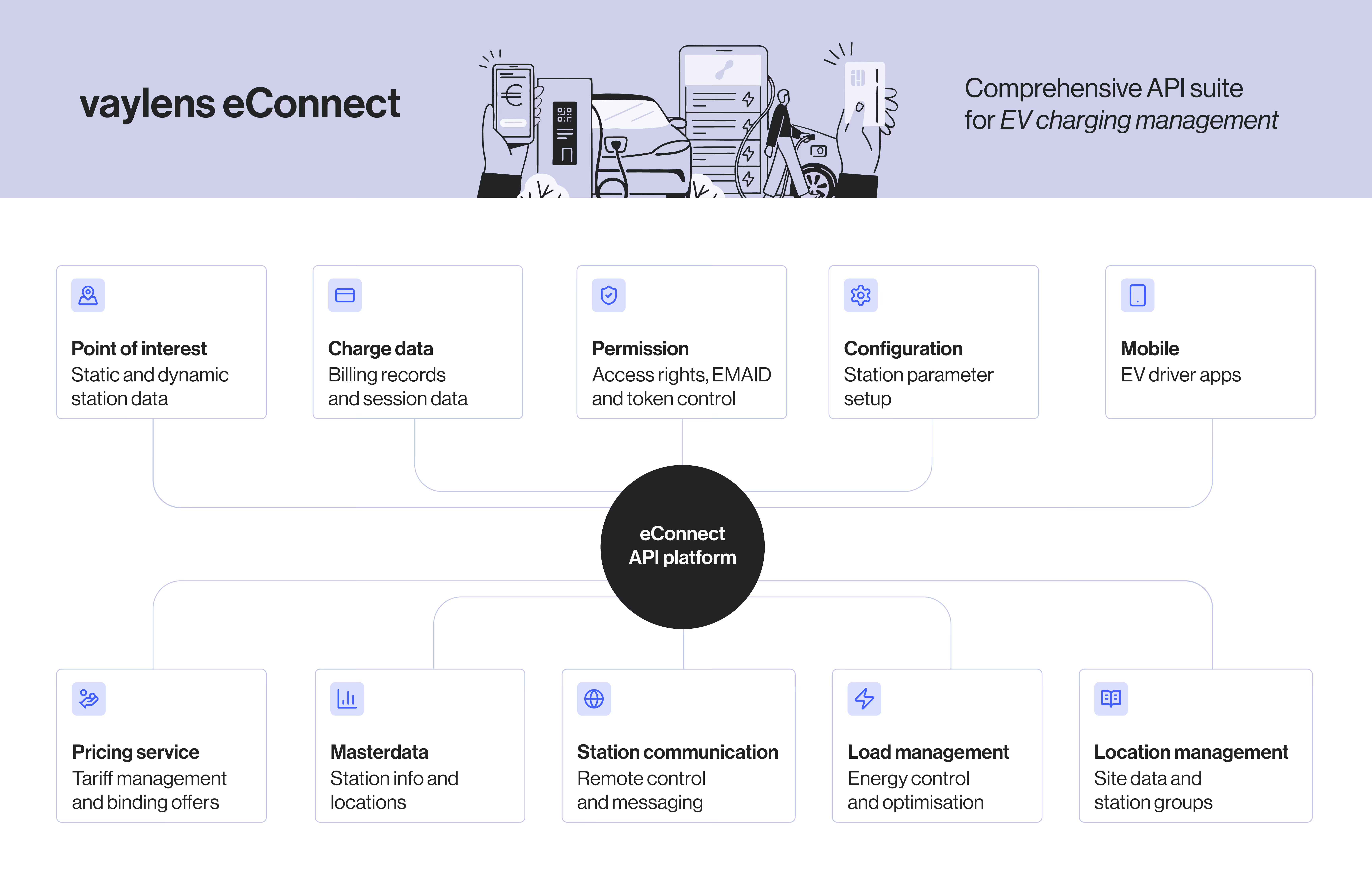
vaylens eConnect provides access to a comprehensive suite of APIs, including Charge Data Records, Permission Management, Configuration Management, Mobile APIs, Pricing Services, Masterdata, Station Communication, Load Management and Location Management. Each API is thoroughly documented with clear endpoints, authentication methods and example implementations to make integration as straightforward as possible.
APIs really can help UK CPOs and fleet operators
APIs for EV charging management software are among the most powerful levers for making charging infrastructure more flexible and valuable for everyone involved in electric mobility. Clean API integration for EV charging automates workflows, reduces errors and ensures your charging environment can grow modularly.
Whether you manage fleets, operate housing developments, provide workplace charging or control public charge points, APIs give you the tools to take your EV charging operation to the next level.
Learn more about the vaylens Portal's capabilities and discover what it could do for your charging operations.
Key takeaways
- APIs automate critical processes in EV charging management to save operators significant time.
- Real-time data improves planning, reporting and monitoring across your operations.
- Systems like fleet management, billing and energy management can be directly connected.
- APIs make EV charging infrastructure modular and scalable as your business grows.
- Every organisation benefits differently, but all experience measurable improvements.
- APIs can create unique selling points for organisations that help increase customer loyalty.
FAQs
Not necessarily. Many API integrations can be set up through existing tools, plugins or partner solutions without requiring programming knowledge. The most important thing is knowing which systems should be connected and for what purpose. Once these basic requirements are clear, IT service providers or software vendors can handle the technical implementation. vaylens provides comprehensive documentation through the eConnect portal to make integration as accessible as possible.
Yes. APIs work with established security standards, encrypted connections and clearly defined authentication mechanisms. This precisely controls who can access certain sets of data. vaylens' eConnect platform implements industry-standard security protocols, including token-based authentication, role-based access control and encrypted data transmission. Professional charging management systems and enterprise systems today exclusively use proven security methods that are used across many industries. This makes API connections reliable and secure, even in critical areas like billing and energy distribution.
Yes, because APIs connect systems rather than replace them. You can continue working with your existing tools and only extend them in areas where you want automation or more transparency. APIs ensure data flows between systems without requiring you to rebuild your entire IT stack. This makes them particularly attractive for operators who want to digitise step by step without major disruption.
As soon as you notice that data is needed in multiple places or processes are manually taking up a lot of time, switching to API-based workflows pays off. The more charge points, locations, or partners involved in your operation, the greater the advantage. APIs help you synchronise data in real-time, reduce errors, and automate recurring tasks. Getting started is especially worthwhile when you want to scale or are already noticing that your existing processes are reaching their limits.
Related articles

Questions every CPO should ask EV charging software providers before signing
Questions every CPO should ask EV charging software providers before signing

How to solve a Charge Point Operator’s biggest EV charging management challenges